

Biometrics…
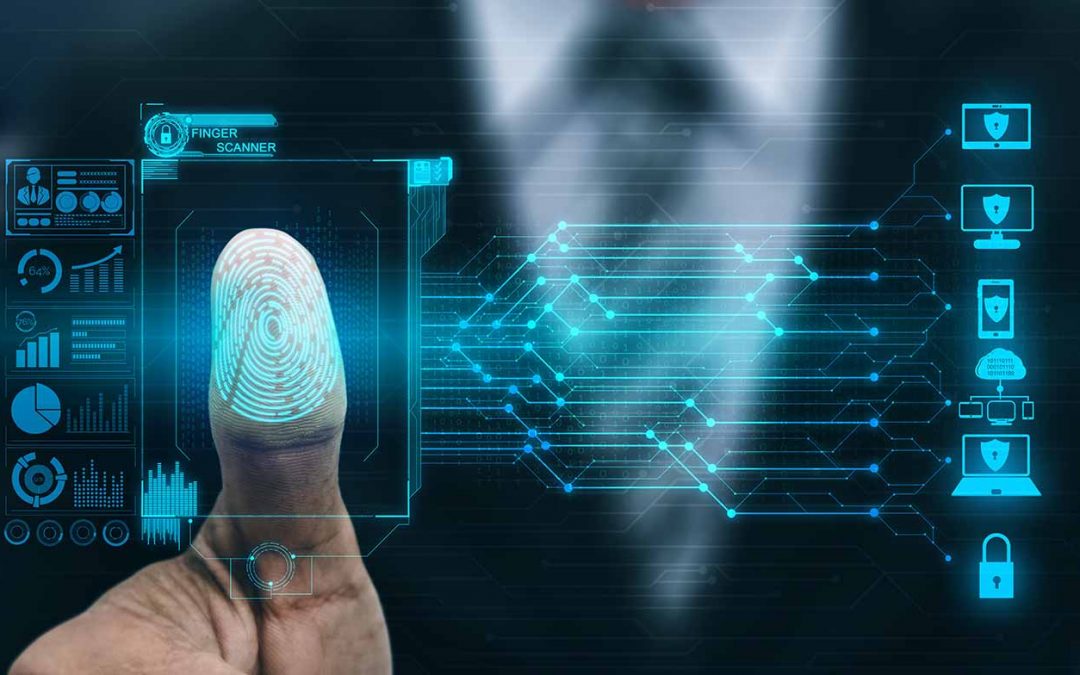
Although biometrics can be used for a wide variety of purposes, the primary purpose is to identify individuals for security purposes. This can be done by making it difficult for an imposter to use a false identity to gain access to a building, computer system, or network. In other cases, biometric technology can be used to track individuals to better understand their activities and movements. Biometric technology is also being used to help develop personalized medicine.
Biometric technology is becoming more and more prevalent in our everyday lives. From mobile phones and computers to transportation and building security, biometric technology is helping to improve our daily lives.
This article will provide an overview of biometric technology and how it is used.
What is Biometric Technology?
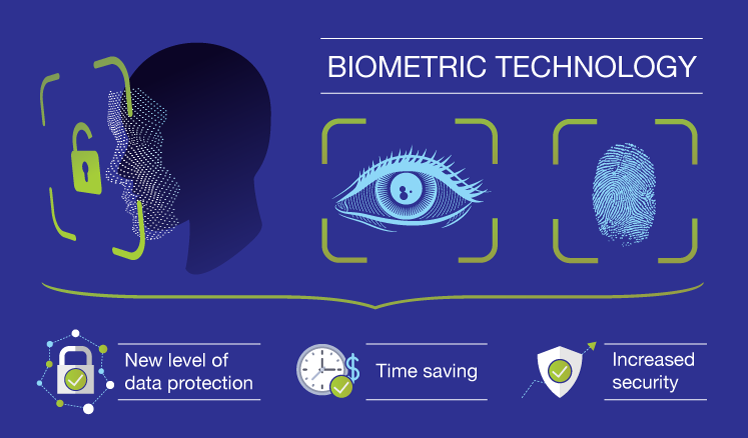
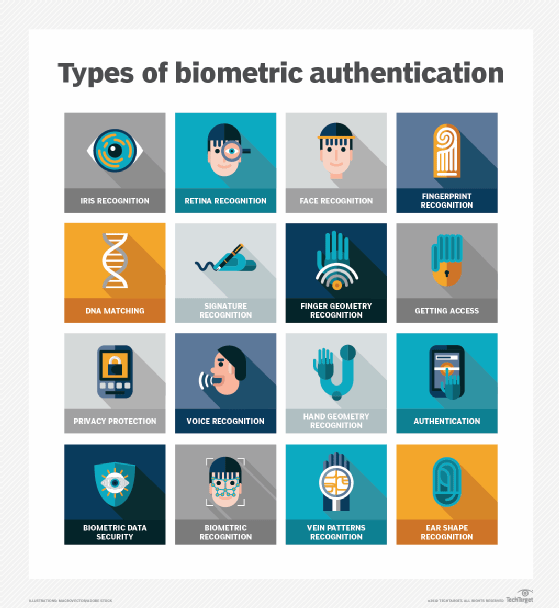
Biometric technology is the use of physical characteristics to identify individuals. The most common biometric technologies are fingerprint recognition, face recognition, retinal scans, iris scans, and voice recognition.
This is a list of biometric technologies, with an explanation of the various aspects of biometric technology. For a more complete description of biometric technologies, see biometrics.
Biometrics are used to identify and verify people based on their biological characteristics, such as their face, fingerprint, voice, retina, or iris. They are also used to authenticate the identity of a person, and to determine whether a person is who they say they are.
Biometric Uses:

Biometric technology uses the physical characteristics of the human body to identify people. For example, fingerprint recognition uses the unique pattern of ridges on the skin to identify people. Facial recognition uses the shape of a person’s face to identify them. Iris recognition uses the unique pattern of blood vessels that run through the iris of the eye to identify people. Retina recognition uses the unique pattern of blood vessels that run through the retina of the eye to identify people.
For example, the fingerprint pattern of a finger can be used to confirm identity, whereas the facial pattern of a face can be used to identify a person. Biometric authentication refers to the use of biometric identification to verify the identity of a person, usually by using biometric data.
Biometric Authentication Systems:
The security of biometric authentication systems is based on the inherent unknowability of the biometric data used to identify an individual. This means that an attacker can attempt to impersonate a person, but he or she cannot copy the biometric data used to identify that person. Biometric authentication is highly secure because it does not require passwords or personal information, such as a social security number or date of birth, to be shared between the user and the authentication system. Biometric authentication also does not require the user to remember any passwords or personal information.
The use of biometric authentication is growing in popularity as the number of available biometric technologies continues to increase.
In this situation, the subject’s DNA is extracted from blood or hair and amplified by polymerase chain reaction (PCR) to generate multiple copies of STRs, which are then read using DNA microarrays. The STRs used in these methods have a high degree of polymorphism and are highly variable between individuals. The repeat unit length of these STRs is typically less than 20 base pairs, and this variability makes it difficult to distinguish between two individuals whose STRs have been amplified by PCR. This is because the probability of a match between two individuals’ STRs is proportional to the product of the repeat unit lengths, and this product is approximately the same for each pair of individuals. In other words, the STRs are very similar, and any differences in the STRs are difficult to detect.
In contrast, other methods of DNA identification have used the differences in base-pair sequence in the DNA. In another case, your face is biometric, and we can identify you by looking at your face. Biometrics can be used for secure transactions, such as credit cards, or for authentication, such as on a smartphone. Biometrics can be used for the identification of individuals or devices.
It is also important to know that biometrics is not a new concept. Humans have used biometrics for thousands of years. For example, fingerprinting was used to identify criminals. People can be identified based on the unique shape of their faces, the pattern of their iris, and the pattern of their retina.
This book introduces the fundamentals of biometrics. We begin by describing the basic principles of biometrics, and then look at how to use biometrics to identify people. We also introduce biometric technologies and discuss how to implement biometric systems. Finally, we discuss the challenges and limitations of biometrics.
Credential and Access Management (CAM)
Biometrics has been used for authentication for a long time. The first biometric technology to be used for authentication was a fingerprint. Other biometric technologies used for authentication include voice recognition, retina and iris recognition, and others.
Biometric technologies can be used for identity verification as well as for authentication. Authentication is the process of confirming that the identity of a user is who he or she claims to be. Identity verification is the process of confirming that a user has the authority to perform a task. For example, in a financial transaction, the authentication process ensures that the person presenting the transaction is who he or she claims to be.
Biometric technologies can be used for both authentication and identity verification. For example, when a user presents a transaction to a financial institution, the authentication process ensures that the user is who he or she claims to be.
Equally important, is the fact that some biometric systems are one of a kind, meaning that they are the only biometric system available on the market. The best-known example of this is fingerprint biometrics.
Fingerprint recognition is the most commonly used biometric for access control. The reason for this is the fact that it is highly reliable, it is easy to obtain and it is cheap to acquire. This is especially true for contact-based biometrics such as fingerprint, palm print, and face recognition. The problem with this type of biometrics is that they can be replicated and for this reason are often used in combination with other biometrics.
The other main type of biometrics is non-contact-based. This type of biometrics includes the retina, iris, and voice recognition. These types of biometrics are highly reliable, as they are difficult to replicate and are also relatively cheap to acquire.